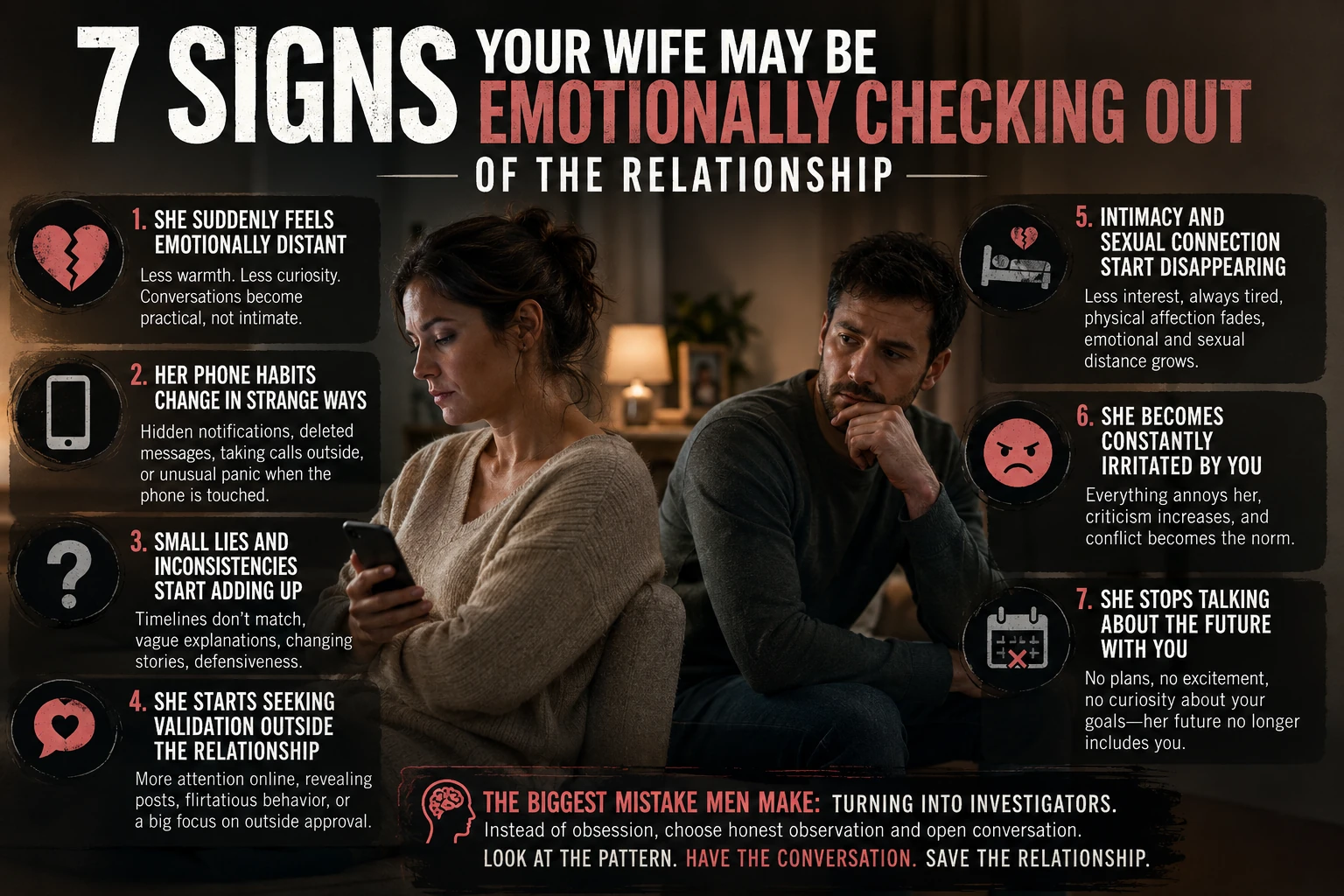
Not every relationship problem means cheating.
It’s important to start there, especially in an era where social media amplifies suspicion. A late reply, a new routine, a slight shift in behavior — and suddenly, the internet jumps to the worst conclusions.
But real relationships don’t operate on shortcuts or viral theories. They evolve slowly, sometimes silently.
Still, when a woman begins to emotionally withdraw from a relationship, certain patterns tend to emerge. Not always because of infidelity — but often because something deeper is shifting beneath the surface.
As an editorialist focused on couple dynamics, I’ve seen how easy it is to either ignore warning signs… or overinterpret them. The truth lies somewhere in between: paying attention without falling into paranoia.
1. She Suddenly Feels Emotionally Distant
One of the earliest and most telling signs is emotional distance.
The conversations are still there — but they feel different. Less warmth. Less spontaneity. Less genuine interest.
What used to be shared freely now feels filtered or absent. Small details disappear. Emotional intimacy fades into routine exchanges.
Many men describe it in similar terms:
“She was still there physically, but something had already left.”
Of course, emotional distance doesn’t automatically mean betrayal. Stress, fatigue, mental health, and life pressure can all affect connection.
But when the shift is abrupt and unexplained, it usually signals that something in the relationship has changed.
2. Her Phone Habits Change in Strange Ways
This is often the first thing people notice — and sometimes the first thing they misinterpret.
Privacy is normal. Secrecy is different.
Concern tends to grow when patterns change:
- the phone always turned face down;
- notifications suddenly hidden;
- messages deleted;
- passwords changed without explanation;
- calls taken in private;
- visible discomfort when the phone is touched.
Individually, these behaviors mean little. But combined with emotional distance, they can create a climate of doubt.
As one man put it:
“It wasn’t about what was on her phone. It was about how it started to come between us.”
That shift alone can erode trust over time.
3. Small Lies and Inconsistencies Start Adding Up
Most relationship breakdowns don’t begin with dramatic revelations.
They begin with small inconsistencies:
- timelines that don’t quite align;
- vague or changing explanations;
- defensiveness over simple questions;
- details that feel slightly off.
At first, each moment seems insignificant. But patterns matter.
Human intuition often picks up on these discrepancies before logic catches up. That’s why many people say:
“I couldn’t prove anything… but I knew something wasn’t right.”
Of course, intuition can be influenced by past experiences or insecurity. But repeated inconsistencies in a relationship should never be dismissed outright.
4. She Starts Seeking Validation Outside the Relationship
This is one of the most misunderstood dynamics.
A woman taking care of her appearance or enjoying attention is not, in itself, suspicious. Confidence is healthy.
But sometimes, a deeper imbalance appears: emotional withdrawal at home paired with increased validation-seeking outside.
That might look like:
- more revealing or attention-driven social media posts;
- heightened online flirtation;
- a noticeable change in how she presents herself in specific contexts;
- increased need for external approval;
- energy invested outward rather than inward.
The issue isn’t the behavior itself — it’s the contrast.
Emotional energy tends to shift before anything physical happens. Many emotional affairs begin not with intention, but with attention.

5. Intimacy and Sexual Connection Start Disappearing
A decline in intimacy is one of the most frequently reported warning signs in long-term relationships.
Sometimes it’s gradual. Sometimes it feels sudden.
Interest fades. Physical connection becomes rare or mechanical. Emotional presence during intimacy weakens.
There are, of course, many valid explanations:
- stress;
- hormonal changes;
- parenting demands;
- health issues;
- emotional exhaustion.
But when sexual disconnection aligns with emotional distance and secrecy, it often signals a broader disengagement.
And avoiding the conversation rarely helps.
6. She Becomes Constantly Irritated by You
This phase can feel deeply personal.
Suddenly, everything seems to trigger annoyance:
- your habits;
- your tone;
- your humor;
- your presence.
Criticism becomes frequent. Patience disappears.
This doesn’t necessarily point to infidelity. It can stem from accumulated resentment, unmet needs, or emotional fatigue.
But in some cases, conflict becomes a way to justify distance.
As one observer of couple dynamics once noted:
“When someone checks out emotionally, they sometimes rewrite the narrative to make leaving easier.”
Not every argument is meaningful. But constant irritation without constructive dialogue often reflects a deeper disconnection.
7. She Stops Talking About the Future With You
This is often the most overlooked — and most telling — sign.
The future quietly disappears.
No shared plans. No excitement about what’s next. No real engagement with long-term goals.
The relationship shifts into maintenance mode.
When someone disengages emotionally, they often stop projecting themselves into the shared future. And sometimes, that mental space is already being filled elsewhere.
This is why emotional disconnection can be more destabilizing than physical infidelity: the investment has already moved.
The Biggest Mistake Men Make When They Suspect Infidelity
Faced with uncertainty, many men turn into investigators.
They monitor.
They check.
They analyze.
They test.
Ironically, this often accelerates the breakdown.
Obsessive suspicion can damage even healthy relationships. And when something is already fragile, it pushes it further toward collapse.
A more constructive approach is simpler — and harder:
- observe patterns, not isolated events;
- assess emotional connection;
- evaluate consistency and transparency;
- prioritize honest, direct conversation.
Because infidelity, in most cases, is not the starting point.
It’s the consequence of something that has been eroding for a long time: distance, resentment, loneliness, or unmet emotional needs.
And sometimes, the conversation people avoid the most is the one that could still change everything.
Frequently Asked Questions
Can emotional distance automatically mean cheating?
No. Emotional distance can come from many things:
- stress,
- depression,
- burnout,
- resentment,
- anxiety,
- hormonal changes,
- unresolved relationship problems.
But when emotional withdrawal appears suddenly alongside secrecy, constant defensiveness, or major behavioral changes, it’s understandable for a partner to start questioning what’s happening.
The important thing is looking at the overall pattern, not obsessing over one isolated sign.
What are the most common signs of emotional cheating?
Emotional affairs often begin long before anything physical happens.
Some common signs include:
- emotional secrecy;
- constant texting with someone new;
- less emotional intimacy at home;
- hiding conversations;
- increased emotional investment outside the relationship;
- comparing your partner to someone else emotionally.
Many people involved in emotional cheating convince themselves “nothing happened” because there was no physical intimacy yet. But emotionally, the connection may already be shifting elsewhere.
Should you confront your wife immediately if you suspect cheating?
Usually, aggressive confrontation makes things worse.
Accusations, phone searches, interrogation, and emotional explosions often push communication into survival mode instead of honesty.
A calmer approach tends to reveal much more:
- observe patterns;
- communicate directly;
- explain what feels different;
- focus on emotional changes instead of acting like a detective.
Sometimes there’s infidelity involved. Sometimes there’s loneliness, resentment, or emotional burnout that was never addressed openly.
Why do some people become distant before cheating?
Because infidelity often starts emotionally before it becomes physical.
Some people mentally disconnect from their relationship first:
- they stop communicating honestly;
- intimacy fades;
- resentment grows silently;
- outside validation becomes more exciting.
That emotional gap can create vulnerability to emotional affairs or physical cheating later on.
Can relationship stress look like infidelity?
Absolutely.
Work pressure, parenting stress, financial anxiety, depression, and emotional exhaustion can create behaviors that resemble cheating:
- less intimacy,
- irritability,
- emotional withdrawal,
- lack of attention,
- reduced communication.
That’s why context matters so much. One sign alone rarely means anything definitive.
Is checking your partner’s phone a good idea?
In most cases, no.
Even when suspicion exists, constant surveillance usually damages trust further and creates unhealthy relationship dynamics.
If a relationship reaches the point where one person feels forced to investigate constantly, the deeper issue is often the breakdown of emotional safety and honest communication.
A difficult conversation is usually healthier than months of silent investigation.
Can a relationship recover after emotional cheating?
Sometimes, yes.
But recovery usually requires:
- complete honesty;
- accountability;
- rebuilding trust slowly;
- understanding why the emotional disconnection happened in the first place.
Many couples focus only on the affair itself while ignoring the deeper relationship problems underneath it.
Healing takes time, and both people have to genuinely want the relationship to survive.
What’s the difference between privacy and secrecy in a relationship?
Privacy is healthy.
Secrecy creates distance.
Privacy means having personal space, private thoughts, and independence while still remaining emotionally open and trustworthy with your partner.
Secrecy usually involves:
- hiding interactions;
- deleting evidence;
- lying;
- becoming defensive;
- protecting specific conversations or behaviors.
That difference matters more than people think.
Can social media increase relationship suspicion?
Definitely.
A lot of online relationship content pushes extreme thinking:
- “trust nobody”;
- “every sign means cheating”;
- “women always emotionally move on first.”
Over time, some men become hyper-alert and start interpreting normal behavior as betrayal.
That mindset can quietly poison even healthy relationships if it goes unchecked.
What should you do if something genuinely feels off in your relationship?
Start with honesty instead of panic.
Pay attention to:
- emotional connection;
- consistency;
- intimacy;
- communication;
- transparency;
- effort from both sides.
Then have a direct but calm conversation about what feels different.
Sometimes the issue is infidelity.
Sometimes it’s emotional disconnection.
Sometimes both people have been silently unhappy for much longer than they realized.